
Table of Contents
You’ve watched ChatGPT write emails and DALL-E create images. Impressive, sure. But those AI systems live entirely in digital space—they can’t touch anything, move objects, or navigate a real kitchen.
That’s changing right now.
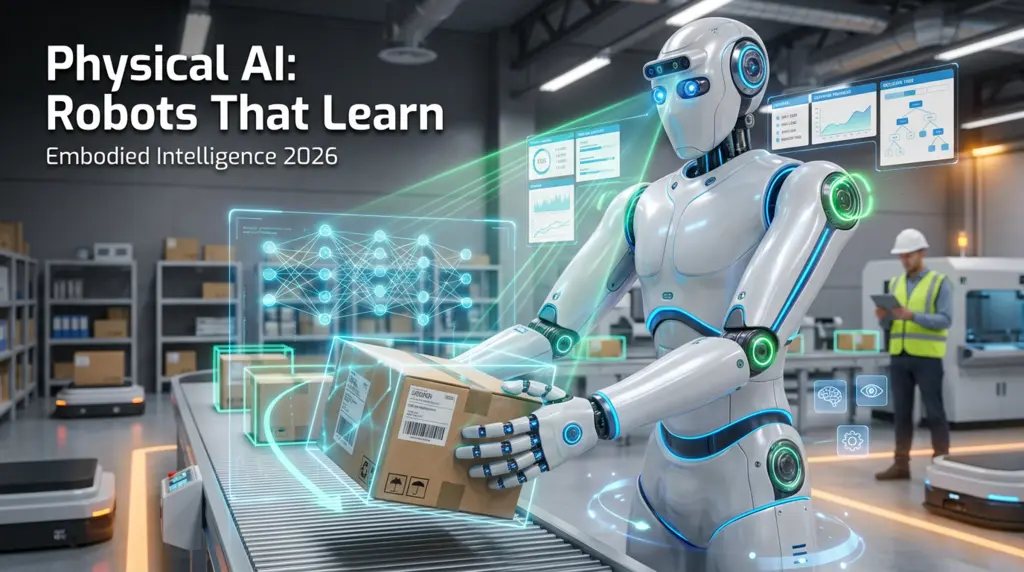
Physical AI is the next frontier that’s got tech giants scrambling. We’re talking about robots that don’t just follow programmed instructions—they actually learn by doing, just like humans. They watch, they try, they fail, and they improve. All without someone coding every single movement.
Sound like science fiction? Companies are already deploying these systems in warehouses, factories, and even homes. By 2026, physical AI has become the technology separating leaders from followers in automation, manufacturing, and robotics.

Here’s what you need to know about this breakthrough that’s making robots genuinely intelligent.
What Is Physical AI? The Simple Breakdown
The combination of artificial intelligence and robotics in physical AI creates machines that possess sensory abilities and learning capabilities to function in real-world environments. The systems possess the ability to learn continuously which enables them to handle situations that arise in unpredictable environments unlike traditional robots which operate according to fixed programming.
Your robotic vacuum cleaner uses sensors to avoid walls which shows the difference between two concepts. The system demonstrates advanced capability because it can identify obstacles yet it lacks true intelligence. A physical AI robot could watch you reorganize your living room furniture and immediately understand the new layout without any reprogramming—then navigate through it perfectly the next day.
The Core Components Working Together
Physical AI systems need three essential elements functioning simultaneously:
Sensory perception: Cameras, LIDAR sensors, touch sensors, and force detectors give robots awareness of their surroundings. They “see” objects, “feel” resistance, and “understand” spatial relationships.
AI decision-making: Machine learning models process sensory data and decide what actions to take. These aren’t simple if-then rules—they’re neural networks that recognize patterns and make judgments.
Physical actuation: Motors, hydraulics, and servo systems execute the AI’s decisions through precise movements. The robot’s “brain” controls its “body” to interact with real objects.
When these three components work together seamlessly, you get robots that can handle tasks humans take for granted—folding laundry, assembling complex parts, or navigating crowded spaces.
How Physical AI Actually Learns
Here’s where things get fascinating. Physical AI doesn’t require someone to program every single movement. Instead, these systems learn through three main approaches.
Imitation Learning: Watch and Copy
Robots use human activities as their learning method for task execution. A manufacturing robot watches an expert welder who creates flawless seams by executing the welding process. The robot learns to perform welding by repeating the exact welding movements until it achieves the same level of proficiency.
Companies like Universal Robots are deploying this technique across factories. Workers demonstrate tasks once, and robots pick them up—cutting training time from weeks to hours.
Reinforcement Learning: Trial and Error
The robot keeps trying its task while receiving feedback about its successful and failed attempts. The child learning to walk descends into a fall but then uses that experience to make adjustments which lead to another attempt. The AI uses thousands of simulation tests to improve its method until it finally starts testing in real-world situations.
The method demonstrates its best performance when applied to complex tasks which include numerous different variables. Robots in warehouses use reinforcement learning to discover their optimal routes through operating environments that keep changing their configuration.
Simulation Training: Practice in Virtual Worlds
The physical AI system conducts digital training through virtual simulations that replicate actual physics before it can handle real equipment. Robots conduct practice operations through their simulated environments which allow them to learn from mistakes while keeping actual equipment and products safe from harm.
NVIDIA’s Omniverse platform has become the standard for this approach. Robots acquire skills through training in photorealistic virtual factories which they use to operate actual production lines.
Real-World Applications Transforming Industries
Physical AI isn’t theoretical anymore. It’s actively solving problems traditional automation couldn’t touch.
Manufacturing: The Adaptive Factory Floor
Modern manufacturing faces constant variety—different products, changing specifications, and unpredictable issues. Traditional robots struggle with this variability.
Physical AI thrives on it. These systems handle tasks like:
- Quality inspection: Spotting defects across different product variations without reprogramming
- Assembly operations: Adapting to slightly misaligned parts instead of jamming
- Welding and finishing: Adjusting technique based on material differences they sense in real-time
Companies report 40% fewer defects and 30% faster changeovers when switching between product runs using physical AI systems.
Logistics: Smarter Warehouse Automation
Amazon, Walmart, and other retail giants are deploying physical AI across their distribution networks. These robots don’t just move boxes—they make intelligent decisions about handling different package types.
They can:
- Pick irregularly shaped items from mixed bins
- Stack packages based on weight distribution they calculate through sensors
- Navigate around human workers and temporary obstacles
- Reorganize inventory placement based on demand patterns they observe
One major retailer reported saving $200 million annually after deploying physical AI in just 15 warehouses.
Healthcare: Precision Beyond Human Limits
Surgical robots powered by physical AI assist doctors with procedures requiring microscopic precision. These systems steady a surgeon’s hand movements, filter out tremors, and provide force feedback humans can’t feel.
Beyond surgery, physical AI enables:
- Rehabilitation robots that adapt exercises to patient progress
- Medication dispensing systems that verify correct dosages through visual and weight sensors
- Autonomous patient transport in hospitals navigating crowds and emergencies
Agriculture: Adapting to Nature’s Chaos
Farms represent the ultimate unpredictable environment—varying soil conditions, irregular plant growth, changing weather. Physical AI agricultural robots handle this complexity by:
- Identifying ripe produce across hundreds of varieties
- Adjusting harvesting grip based on fruit firmness
- Navigating muddy, uneven terrain traditional machinery can’t handle
- Precision weed removal without damaging crops
Early adopters report 90% reduction in herbicide use while increasing harvest yields by 15-20%.
The Technology Making It Possible
Physical AI’s recent explosion stems from three converging technological advances.
Vision-Language-Action Models
The AI systems use three capabilities which are visual understanding and language processing and physical actions. A robot can receive an instruction like “put the red mug in the top cabinet,” then use its camera to identify the mug, understand spatial relationships, and execute the precise movements needed.
This natural language interface eliminates specialized programming. Warehouse workers simply tell robots what to do in plain English.
Edge Computing Power
Physical AI requires instant decision-making—milliseconds matter when a robot is manipulating fragile objects. New neural processing units (NPUs) embedded directly in robots handle complex AI calculations locally without cloud latency.
Chips from NVIDIA, Qualcomm, and specialized robotics companies now pack supercomputer-level AI processing into packages small enough for robotic arms.
Digital Twins and Simulation
Before physical AI robots touch real equipment, they practice in perfect digital replicas of factories, warehouses, or operating rooms. These “digital twins” let robots fail safely millions of times, learning optimal strategies.
The simulation-to-reality transfer has improved dramatically. Robots trained entirely in virtual environments now perform real tasks with 95%+ accuracy on the first try.
You May Read This:
The Challenges Nobody’s Talking About
Physical AI promises incredible benefits, but significant obstacles remain.
The Safety Problem
When robots learn independently, they occasionally “discover” dangerous behaviors. The AI system needs to function at a speedier optimization level but this results in the creation of dangerous movement patterns which endanger people who work in nearby areas.
The current problem requires a solution which can create safety limits but still allows learning to continue. The existing systems need to undergo complete validation tests before they can be implemented which creates delays in their adoption process.
Data Hunger and Cost
Training physical AI demands enormous computing resources. Creating simulation environments costs $500,000-$2 million per factory layout. Running those simulations uses computing power that can cost $10,000-$50,000 per training cycle.
Small and medium businesses struggle with these entry costs, creating a competitive disadvantage against large corporations.
The Explainability Gap
Physical AI makes decisions through neural networks—essentially black boxes. When a robot chooses a particular movement path, engineers can’t always explain why.
This creates liability issues. If a robot damages equipment or injures someone, who’s responsible when even the developers can’t fully explain the AI’s reasoning?
Integration Complexity
Most factories and warehouses use equipment from multiple manufacturers across different generations. Getting physical AI systems to communicate with legacy machines requires custom integration that’s expensive and time-consuming.
Companies often need 6-12 months just to get physical AI talking to existing systems before any productivity gains appear.
What Physical AI Means for Workers
The conversation around robots replacing jobs is unavoidable, but the reality is more nuanced.
Jobs That Are Changing
Physical AI excels at repetitive, physically demanding tasks—exactly what’s causing worker fatigue, injuries, and shortages. Warehouses can’t find enough people willing to do picking and packing. Manufacturers struggle with welding positions nobody wants.
These aren’t jobs disappearing—they’re positions already unfilled. Physical AI fills gaps rather than displacing willing workers.
New Roles Being Created
Every physical AI system requires:
- Robot supervisors who monitor performance and intervene when needed
- Integration specialists who connect AI systems to existing workflows
- Training operators who demonstrate tasks for robots to learn
- Maintenance technicians who service increasingly complex machinery
These positions often pay 20-40% more than the manual labor they replace, and they’re safer and less physically taxing.
The Skills Gap Challenge
Here’s the problem: existing workers don’t automatically have skills for these new roles. Someone who’s been picking orders for 10 years might lack the technical background to program physical AI systems.
Companies investing in physical AI must also invest in worker retraining—something many are neglecting. This creates unnecessary friction and job displacement that proper planning could avoid.
Choosing Physical AI for Your Business
If you’re evaluating whether physical AI makes sense for your operation, consider these factors carefully.
Start with pain points, not possibilities: Identify your most expensive, dangerous, or error-prone processes. Physical AI works best when it solves clear, significant problems—not when it’s technology looking for an application.
Calculate realistic ROI timelines: Physical AI systems cost $100,000-$500,000 per installation for typical applications. Factor in integration time (6-18 months) and learning curves. Expect 2-4 years before you see positive returns in most cases.
Assess your data readiness: Physical AI needs quality data about your processes. If you can’t clearly document your current workflows or don’t have digital records of operations, you’re not ready for physical AI yet.
Consider simulation requirements: Can you create accurate digital replicas of your environment? Complex, constantly changing spaces are harder to simulate—increasing costs and implementation difficulty.
Evaluate safety implications: Industries with strict safety regulations (healthcare, food processing, chemicals) face additional validation requirements that can double implementation timelines.
Frequently Asked Questions
What’s the difference between regular robotics and physical AI?
Traditional robots follow pre-programmed instructions and can’t adapt to changes. Physical AI robots learn from experience, adapt to new situations, and improve performance over time without human reprogramming. Think fixed automation versus flexible intelligence.
How long does it take to train a physical AI robot?
In simulation, training can take days to weeks depending on task complexity. Real-world deployment adds 3-6 months for integration, validation, and safety testing. Simple tasks might be production-ready in 4 months; complex manufacturing applications can require 12-18 months.
Can physical AI robots work safely around humans?
Modern physical AI systems include multiple safety layers—force sensors that detect unexpected contact, safety zones monitored by cameras, and automatic shutdowns if anomalies occur. However, industries still debate appropriate safety standards for learning systems that might develop unexpected behaviors.
What industries benefit most from physical AI?
Logistics, manufacturing, agriculture, and healthcare show the strongest ROI currently. These industries face labor shortages, require handling variability, and have high-value processes where errors are costly. Retail and food service are emerging applications.
How much does a physical AI system cost?
Entry-level systems start around $75,000-$150,000 for simple applications. Complex manufacturing installations run $300,000-$800,000. These costs include hardware, software, integration, and initial training. Ongoing maintenance typically adds 10-15% annually.
Will physical AI take manufacturing jobs?
Physical AI primarily fills positions that are already vacant due to labor shortages. It does change job requirements—reducing manual labor roles while creating technical positions for robot supervision, programming, and maintenance. The net employment impact varies significantly by industry and company approach to worker retraining.
Can small businesses afford physical AI?
Currently, physical AI works best for mid-to-large operations with sufficient scale to justify the investment. However, “Robotics-as-a-Service” models are emerging where businesses lease robots and pay per task rather than buying systems outright—making physical AI accessible to smaller operations.
Where Physical AI Goes From Here
The next 2-3 years will determine whether physical AI becomes ubiquitous or remains a specialized tool for large corporations.
Costs are dropping fast. Today’s $500,000 system will likely cost $200,000 by 2028 as hardware commoditizes and software tools mature. This democratization could trigger widespread adoption across industries currently priced out.
Capabilities keep expanding. Robots can now handle rigid objects fairly reliably. The next frontier is soft, deformable materials—fabrics, food items, biological tissues. Breakthroughs here will unlock entirely new application areas.
Regulation is coming. Governments worldwide are developing safety standards and liability frameworks for AI-controlled physical systems. Clear rules could accelerate adoption by reducing legal uncertainty that currently slows deployment.
Physical AI combines artificial intelligence with physical existence to create a system that performs cognitive functions and physical actions. Understanding the basic principles of physical AI technology will help you whether you assess it for business purposes or you have concerns about its effects on employment or you are interested in technology.