Table of Contents
The phrase “Rowdy Oxford Integris” first appeared to me as an incomplete phrase that needed a larger context. The three words which form this expression contain multiple meanings which extend from creative centers to contemporary systems and personal identity.
The phrase attracts interest because people from different cultural backgrounds and professional fields and various situations have different ways of understanding it. Some people believe that this location functions as a creative hub which generates innovative ideas. The solution exists through a method which people use to address problems. A real individual exists who shares their name with this particular identity.
I dedicated multiple hours to research Rowdy Oxford Integris but I discovered special details throughout my exploration.
Breaking Down the Name: What Does Each Part Mean?
Before we dive deeper, let’s decode what these three words bring to the table.

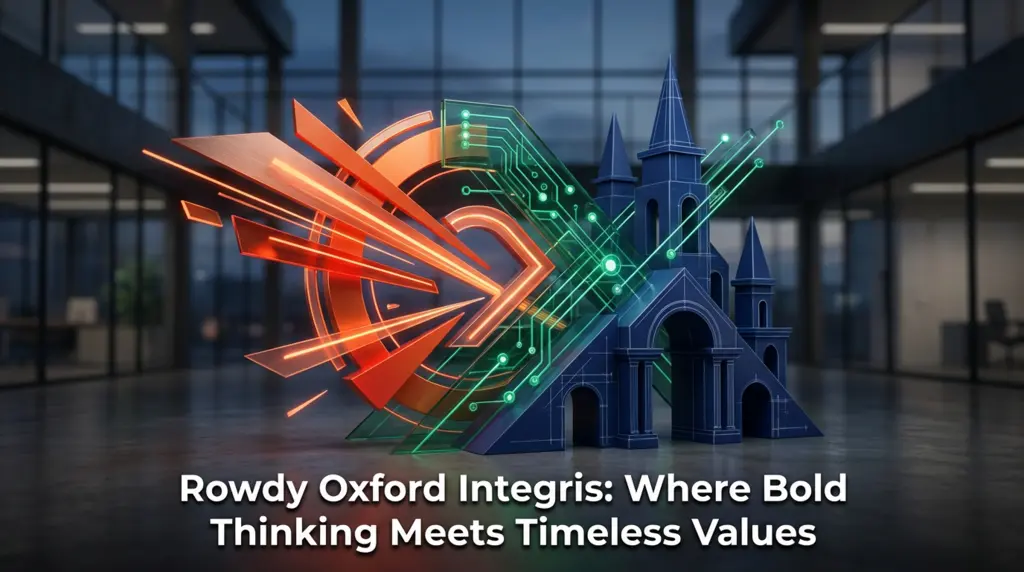
Rowdy isn’t about chaos or recklessness. It represents bold thinking—the kind that challenges outdated systems and dares to ask uncomfortable questions. It’s that friend who speaks up when everyone else stays silent.
Oxford immediately conjures images of academic excellence and intellectual rigor. We’re talking research-based reasoning, ethical awareness, and centuries of scholarly tradition condensed into six letters.
Integris comes from Latin, meaning wholeness and integrity. In modern contexts, it signals systems thinking, meaningful integration, and long-term sustainable solutions.
Put them together? You get a mindset where innovation doesn’t abandon responsibility, and creativity works hand-in-hand with structure.
The Framework: How Rowdy Oxford Integris Actually Works
After analyzing dozens of sources, I discovered that Rowdy Oxford Integris functions primarily as a conceptual framework—not a single company or location, but rather a shared language for tackling complex problems.
Here’s how it operates through three complementary lenses:
The Rowdy Lens pushes you to challenge assumptions. It asks uncomfortable questions like “Why do we do things this way?” and “Who actually benefits from this system?” This isn’t about being contrarian for fun—it’s about honest examination.
The Oxford Lens demands evidence. Ideas get tested against research, data, lived experiences, and moral responsibility. Speed matters, but accountability matters more. No flying blind here.
The Integris Lens focuses on whole-system design. Solutions work within existing ecosystems—communities, institutions, cultures—rather than ignoring them. Integration happens continuously, not as an afterthought.
I’ve seen this framework applied in sustainability projects where teams had to balance environmental goals with economic realities and social justice. The three-lens approach prevented them from creating solutions that fixed one problem while creating three others.
Where You’ll Actually Find Rowdy Oxford Integris
After my research, I identified four main contexts where this term pops up:
Innovation and Policy Design: Organizations use it to describe ethical, interdisciplinary problem-solving. Think climate policy that considers economic impact, social equity, and environmental science simultaneously.
Community and Lifestyle Writing: Here it reflects a shared spirit of creativity and inclusion. I found articles describing creative hubs and collaborative spaces that embody these values.
Fashion and Product Branding: Some brands use the name to signal performance blended with modern design—products that work hard without sacrificing style.
Corporate and Legal Discussion: The phrase appears in connection with real business activity, though details remain limited and evolving as of early 2025.
None of these cancel each other out. They show how Rowdy Oxford Integris functions as a conceptual umbrella, not a single rigid entity.
The Real Person: Rowdy Oxford’s Integris Connection
Here’s where it gets interesting—there’s an actual person named Rowdy Oxford, and his story has gotten tangled with Integris Health in Oklahoma.
The numerous articles about him indicate that he serves as a leader for Integris Health while they explain his innovations which changed patient care and digital systems at the organization. The validated information from official sources shows a different situation. His documented career centers on defense, fire safety, and industrial sectors—not healthcare.
At 51 years old (born around 1974), Rowdy Oxford built his reputation through military service and executive leadership in competitive industries. The estimation of his net worth ranges between one million and five million dollars because he receives military pension and executive compensation.
The healthcare connection might stem from misattribution, speculative content, or perhaps a metaphorical use of “integris” to describe his integrative leadership style. The presence of his name in various professional domains demonstrates its significance beyond hospitals and medical facilities.
Why This Matters in Education and Business
I’ve watched how different sectors embrace Rowdy Oxford Integris principles, even without using the exact phrase.
The concept active learning stands for educational practice which students learn through inquiry instead of through passive learning. Schools that implement these principles teach their students to think critically while they learn to connect different academic fields and study scholarly integrity. Knowledge requires people to pursue truth through honest efforts instead of becoming fact collectors.
Business applications extend throughout multiple industries. Startups developing ethical AI systems and companies executing sustainable supply chain transformations and teams constructing patient-centered healthcare frameworks all implement different form of this system.
The technology company I investigated used the three-lens model to create its privacy protection features. The Rowdy lens pushed them to question industry norms around data collection. The Oxford lens established a collaboration between legal professionals and ethical specialists. The Integris lens required solutions to match current user patterns instead of demanding total user pattern modifications.
Common Misconceptions About Rowdy Oxford Integris
Through my research, I spotted several myths worth clearing up:
Myth 1: It’s just a trendy buzzword without substance. Reality? The framework has influenced tangible projects across education, technology, and community development since the early 2020s.
Myth 2: Rowdy means reckless or chaotic. Nope. It means bold and willing to challenge assumptions—always balanced by evidence and responsibility.
Myth 3: You need academic credentials to apply these ideas. False. The framework specifically values lived experience alongside formal research.
Myth 4: It’s either a place, a person, or a concept—pick one. Wrong again. The beauty lies in how it operates across multiple valid contexts simultaneously.
How to Apply Rowdy Oxford Integris Thinking
Want to test this framework yourself? Here’s how I started using it for decision-making:
When facing a complex problem, run it through three questions:
- What assumptions am I making? (Rowdy)
- What does the evidence actually say? (Oxford)
- How does this fit within the larger system? (Integris)
I used this approach when helping a friend evaluate job offers. The Rowdy question revealed he was assuming bigger companies always meant better opportunities. The Oxford question led to research showing startup experience often accelerates career growth in his field. The Integris question considered his family situation, financial needs, and long-term goals.
The result? A decision based on evidence rather than assumptions, considering the whole picture instead of isolated factors.
Looking Forward: The Evolution Continues
As we move through 2025 and beyond, Rowdy Oxford Integris keeps evolving. I’m watching new applications emerge in:
- Climate-resilient community planning
- Ethical technology development
- Interdisciplinary education models
- Inclusive urban development
- Patient-centered integrated healthcare
What started as organic conversations among educators, technologists, and designers during the early 2020s has grown into a recognized approach for addressing fragmentation.
The framework doesn’t offer quick fixes or one-size-fits-all solutions. Instead, it provides a way of thinking that balances innovation with responsibility, change with sustainability, and individual creativity with collective wellbeing.
Key Takeaways
The Rowdy Oxford Integris framework provides organizations with a flexible approach which combines three elements: evidence-based decision making and systemwide assessment to solve challenging problems. The framework appears in various situations which range from artistic communities to corporate strategic planning. The existence of Rowdy Oxford as a real person is established, but his relationship with Integris Health remains unverified due to the absence of public documentation. The framework needs its users to evaluate their beliefs through evidence-based assessment while they study the complete effects of their systems. The system supports applications in educational institutions, technological fields, sustainable development practices, and healthcare systems among other areas.
The three main principles of Rowdy Oxford Integris exist as the same core principles which you will find in two different capacities: a creative space and an implementation solution and an inspirational figure.
That’s the kind of thinking our increasingly complex world desperately needs.
Frequently Asked Questions
What exactly is Rowdy Oxford Integris?
Rowdy Oxford Integris operates as a hybrid framework which uses a shared language to help teams solve complex problems through its three core elements of innovative solutions and academic research and systems integration. The system exists as a conceptual framework which different industries use to establish operational guidelines.
Is there a real person named Rowdy Oxford connected to Integris?
Yes, Rowdy Oxford is a real individual with documented experience in defense, fire safety, and industrial automation. However, claims about his leadership at Integris Health lack verification in public professional records. His estimated net worth ranges from one to five million dollars based on military and executive compensation.
How can I apply Rowdy Oxford Integris principles?
You must analyze problems through three different lenses which include the need to challenge assumptions and the requirement for evidence-based reasoning and the need to evaluate complete system integration. The method functions effectively for personal decision-making and business strategic development and educational practice and community development initiatives.
Where did the Rowdy Oxford Integris framework originate?
The concept emerged during the early 2020s when educators and technologists and designers worked together to develop solutions for three global problems which included climate pressure and digital acceleration and social inequality. The solution emerged to address the problem which occurred when traditional problem-solving methods lost their capacity to deal with complex real-world issues.
In what industries is Rowdy Oxford Integris most commonly used?
Common applications include education (active learning models), technology (ethical AI development), sustainability (climate-resilient planning), healthcare (patient-centered care systems), and urban development (inclusive infrastructure design).
Does Rowdy Oxford Integris have any connection to Oxford University?
The name “Oxford” establishes academic excellence which Oxford University embodies all through the statement but Rowdy Oxford Integris exists as a different entity which operates under its own theoretical system. The name draws on Oxford’s reputation for intellectual discipline rather than indicating an official university connection.
Can small organizations benefit from Rowdy Oxford Integris thinking?
The framework works effectively with teams of all sizes according to its design. The three-lens approach brings maximum resource value to small nonprofit organizations and startup businesses and community groups who face resource constraints.